Tones
Table of contents
Tones Introduction
Pitchrefers to the number ofglottal pulses1 per second (Hz)Pitchis an equivalent term forFundamental FrequencyorF0or if you’re quirky, glottal pulses per second!- More
glottal pulses=> higherpitch
Tonesarepitchmodulations (changes) throughout an utterance- Ex: the IPA denoted
53tone would be ahigh pitchatonsetthenlow pitchfollowing - The modulation of
F0throughout an utterance is known as aPitch Contourwhich can be plotted asF0 vs. Time
- Ex: the IPA denoted
- From a
Gestural Framework, thegoalofHigh ToneorLow Toneare achieved by constrictions of thearticulatorsor muscles in the lower portion of theVocal Tract
| High Tone | Low Tone | |
|---|---|---|
| Tension Goal | Increase Longitudinal Tension | Decrease Vertical Tension |
| Articulator Goal | Increase Angle between Cricoid and Thyroid Cartilages | Lower Larynx |
| Muscle Involved | Crico-thyroid muscle | Strap muscle (sterno-hyoid/thyrohiyoid) |
IPA Tone Transcription
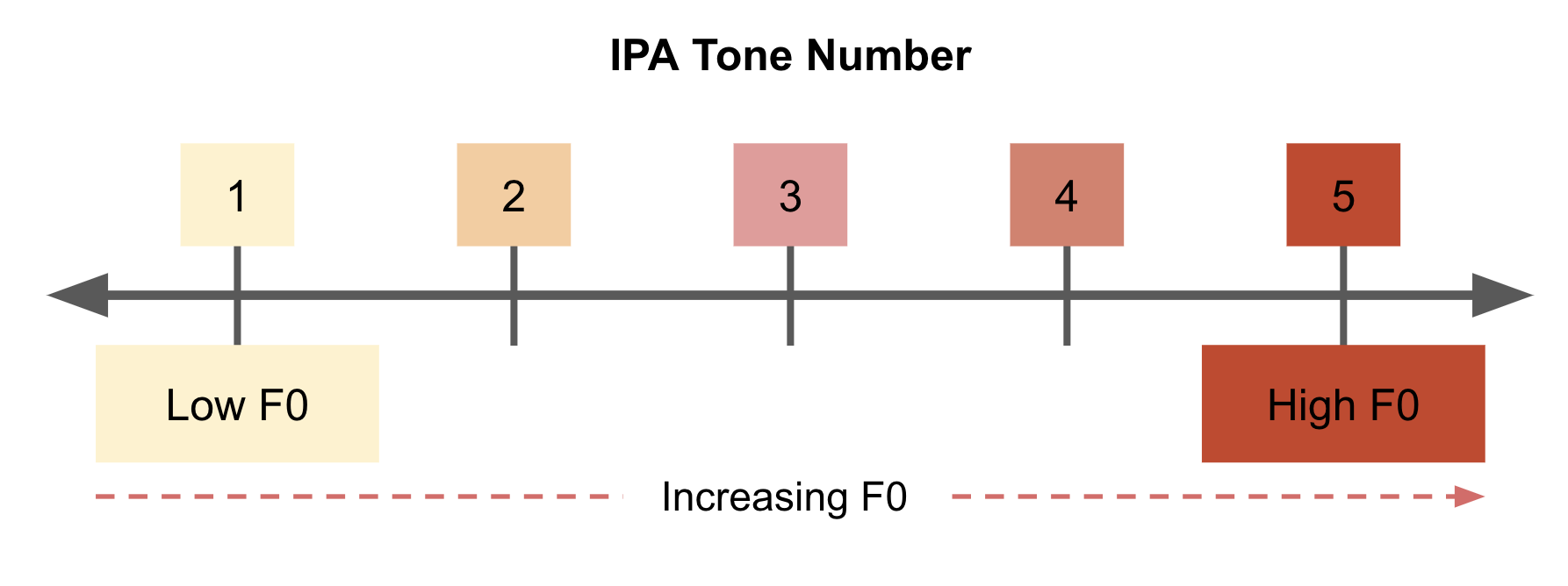
Due to historical reasons, the use of numerical values for tones is quite ambiguous; this section hopes to clear this ambiguity.
- Following the primary resource
Learn Teochew’s Tones Section, we will follow that on the scale of tones from1to5, the lower the number, the lower theF02
| Numerical IPA Tone Markings |
|---|
 |
List of Tones
Tone Class
- In
Teochewthere are 2Tone Classes: eitherlow3 orhigh4F0lowmeans that the F0 begins lowhighmeans that the F0 beings high- Note: after the initial onset pitch, the utterance may be modulated (either go higher or lower depending on the
Tone Category)
| Tone Class | Starting F0 | Teochew Transcription | Corresponding IPA Tones | Corresponding Peng’im Tones |
|---|---|---|---|---|
| low | low | 阴 | 33 53 213 2 | 1 2 3 4 |
| high | high | 阳 | 55 35 11 5 | 5 6 7 8 |
Tone Category
- In addition to
Tone Class, each Tone can be modulated with aTone Category(either increase or decreaseF0depending on the onsetF0orTone Class)
| IPA Tone Example | Corresponding Peng’im Tones | F0 Modulation | English Transcription | Teochew Transcription |
|---|---|---|---|---|
3355 | 15 | Constant | Level | 平 |
535356 | 26 | Starts in opposite Tone Class and ends in the Tone Class | Rising | 上 |
21311 | 37 | If starts with low initialTone Class, F0 dips and then rises to higher Tone ClassConstant if starts with low Tone Class7 | Departing | 去 |
25 | 48 | Constant (Glottal Stop final) | Entering | 入 |
Combinatorial Tones
- Each of the categories and tones combine combinatorially to yield the tone table below
Total_Tones = Number_Tone_Classes * Number_Tone_Types

Total_Tones_in_SwaTao = 2 Tone Classes * 4 Tone Types
Total_Tones_in_SwaTao = 8
Tone Classification
- The table below reiterates the information above and maps the relationship between Tone Class and Tone Category with IPA
pitch contour,Peng'imtone number, and written Chinese tone orthography
| IPA Number | Peng’im Tone # | Tone Type (English) | Tone Class (English) | Tone Type (Teochew) | Tone Class (Teochew) |
|---|---|---|---|---|---|
| 33 | 1 | Low | Level | 阴 | 平 |
| 53 | 2 | Low | Rising | 阴 | 上 |
| 213 | 3 | Low | Departing | 阴 | 去 |
| 2 | 4 | Low | Entering | 阴 | 入 |
| 55 | 5 | High | Level | 阳 | 平 |
| 35 | 6 | High | Rising | 阳 | 上 |
| 11 | 7 | High | Departing | 阳 | 去 |
| 5 | 8 | High | Entering | 阳 | 入 |
Pitch Contour
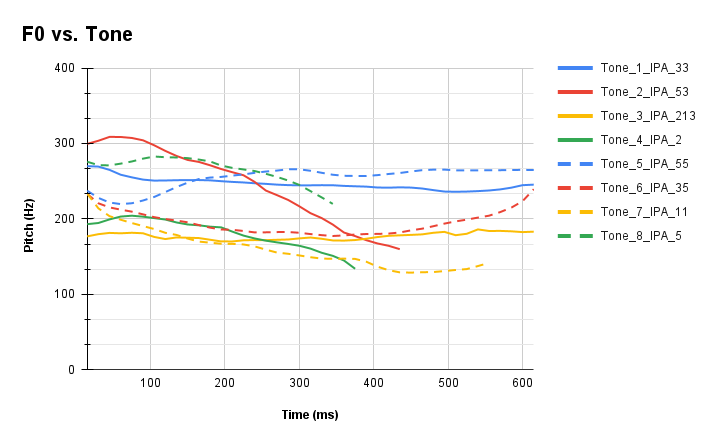
- Below, each of the tone modulations are plotted as
F0vs.Time - Each line type (solid or dashed) represents a
Tone Type(High or Low) while color represents a Tone Category (Level, Rising, Departing, Entering)
F0 Calculation Method
- Since
F0modulation occurs during the vowels rather than the shortonsetconsonants, I extracted the Formant Listing during the vowels in a/CV/context - In Praat, I used
Pitch>Pitch Listing - Plotted the tones and did not truncate the length (see tones
2and5are much shorter than the rest of the tones)
| Pitch Contour |
|---|
 |
| Tone Parameter Type | Tone Parameter | Graph Representation |
|---|---|---|
| Tone Type | Low | Solid Line |
| High | Dashed Line | |
| Tone Category | Level | Blue |
| Rising | Red | |
| Departing | Yellow | |
| Entering | Green |
Pitch Contour Analysis
- Comparing
Tone TypeandTone Category
Tone Type Analysis
- With the exception of the
Departingtone, allHighTone Typeend higher than theirLow Tone Typecounterpart - With the exception of the
Enteringtone, allHigh Tone Typecontours curve upward towards the end of the tone gesture
Tone Category Analysis
| IPA Tone Example | Corresponding Peng’im Tones | English Transcription | Findings |
|---|---|---|---|
3355 | 15 | Level | F0 seems to “settle” and hold constant after ~200 ms |
535356 | 26 | Rising | Tone modulation starts in the opposite Tone Type and ends in the target Tone Type |
21311 | 37 | Departing | Low Tone Type seems to follow the 213 modulationHigh Tone Type seems to follow the opposite of Rising rather than Departing where the tone ends in the opposite Tone Type |
25 | 48 | Entering | Both Tone Types contour downwards–decrease in F0 perhaps due to the final glottal adduction/glottal stop |
- It is not possible to directly draw a correlation between tone and vowel length as the contrastive tone pairs are not minimal. See Future Investigations for more details.
-
One
glottal pulseis the “round trip” of the 2 halves of the vocal folds from being blown apart by thepulmonic airstreamand pulled back together bylow pressurecreated byBernoulli Forces↩ -
While working on this project, I accidentally reversed the tone markings! Seems like this happens in African vs. Asian Tone transcriptions too ↩
-
Low is also called “Dark” or
阴in some literature ↩ -
High also called “Light” or
阳in some literature ↩ -
53isLowTone Class:F0Modulation goes fromHigh(5) toLow(3) ↩ ↩2 -
35isHighTone Class:F0Modulation goes fromLow(3) toHigh(5) ↩ ↩2 -
See the Pitch Contour section for the discrepancy between the expected “constant” tone versus the recorded decrease in
F0↩