Consonants
Table of contents
List of Consonants
- Initial list of consonants and common phrases to illustrate the relationship between the
Peng'imand IPA transcriptions1- Note: Viewing the whole table may require scrolling horizontally
| IPA | Peng’im | IPA Transcription | Peng’im Transcription | English Gloss | SwaTao Gloss | Mandarin Gloss |
|---|---|---|---|---|---|---|
| /p/ | b | /pa/ | a1ba1 | Dad | 阿爸 | 爸爸 |
| /pʰ/ | p | /pʰoʊ/ | pou1 | To spread a cloth | 铺 | 铺 |
| /b/ | bh | /buaŋ/ | bhuang7 | 10,000 | 万 | 万 |
| /t/ | d | /di gɔ/ | di7 go3 | Where | 底块 | 哪里 |
| /tʰ/ | t | /suã taʊ/ | suan1 tao5 | Swa Tao (Dialect and Region) | 汕头 | 汕头 |
| /ts/ | z | /tsek/ | zêg8 | 1 | 一 | 一 |
| /tsʰ/ | c | /tsʰik/ | cig4 | 7 | 七 | 七 |
| /z/ or /dz/ | r | /dzi/ | ri7 | Word | 字 | 字 |
| /k/ | g | /kau/ | gao2 | 9 | 九 | 九 |
| /kʰ/ | k | /gɯŋ kɯe/ | gong1 kue3 | Homework | 功课 | 功课 |
| /g/ | gh | /gaɪ/ | gai5 | Particle (What/thing) | 个 | 个 |
| /ʔ/ | -h | /hiẽ/ | hiên1 | Village | 乡 | 乡 |
| /m/ | m | /mi/ | mih8 | Particle (What/thing) | 乜 | 什么 |
| /n/ | n | /no/ | no6 | 2 | 兩 | 兩 |
| /ŋ/ | ng | /ŋou/ | ngou6 | 5 | 五 | 五 |
| /ŋaŋ/ | ngang5 | In Cantonese/Mandarin means to coagulate, in Teochew means to be cold | 凝 | 冷 | ||
| /s/ | s | /sã/ | san1 | 3 | 三 | 三 |
| /h/ | h | /hak/ | hak4 | Learn/School | 学 | 学 |
| /l/ | l | /leŋ/ | lêng5 | 0 | 零 | 零 |
Phonetically Rich Sentences
In order to illustrate the phonetic contrasts of phonemes (ex: /p/ vs. /pʰ/ vs. /b/), the speaker produced the sentences below. Note: Since Learn Teochew is based off of Teochew Proper video tutorials, the transcriptions were updated after analyzing the speaker’s segments in Praat.
Labial Stops /p/ /pʰ/ /b/
| IPA Transcription | Peng’im Transcription | SwaTao Gloss | Chinese Gloss | English Gloss |
|---|---|---|---|---|
| /i gaɪ/ /boʊ/ /dɯɔ/ /tsʌŋ deŋ/ /pʰoʊ/ /poʊ/ | i1-gai5 bhou2 do6 ceng1-dêng2 pou1 bou3 | 一个 𡚸 在 床顶 铺 补 | 你的 妻子 在 床 单 铺 | Your Wife Is Bed Sheet Spreading |
Alveolar Stops /tʰ/ /t/
| IPA Transcription | Peng’im Transcription | SwaTao Gloss | Chinese Gloss | English Gloss |
|---|---|---|---|---|
| /tʰaʊ/ /ge/ /aɪ/ /pɯe/ /tau:/ /ge/ | tao5 gê1 ai3 boi2 dao7 ghê6 | 头 家 爱 买 豆 芽 | 老 板 爱 买 豆 芽 | The Boss Likes Selling Bean Sprouts |
Velar Stops /k/ /kʰ/ /g/2
| IPA Transcription | Peng’im Transcription | SwaTao Gloss | Chinese Gloss | English Gloss |
|---|---|---|---|---|
| /kɯ/ /mɪŋ/ /kʰɯ/ /o/ /hoʔ/ /gɯ/ | gê1 ming1 ke3 oh8 gog4 ghe2 | 居 民 去 学 国 语 | 居 民 去 学 国 语 | Resident Goes Learn Mandarin |
Alveolar Affricates /ts/ /tsʰ/ /dz/
| IPA Transcription | Peng’im Transcription | SwaTao Gloss | Chinese Gloss | English Gloss |
|---|---|---|---|---|
| /wa/ /tsi/ /tsɯŋ/ /luo/ /tsʰi/ /kiã/ /bo/ /piaŋ/ /sia/ /dzi/ | ua2 zi2 hue5 lo1 ci7 gian2 bho5 biang3 sia2 ri7 | 我 这 回 啰 飼 仔 無 變 寫 字 | 我 在 喂 孩子 不 方便 写 字 | I Am Feeding Child Not Convenient Write Words |
Fricatives /s//h/
| IPA Transcription | Peng’im Transcription | SwaTao Gloss | Chinese Gloss | English Gloss |
|---|---|---|---|---|
| /naŋ/ /eŋ/ /gaɪ/ /siẽ/ /hu/ /hiẽ/ /li/ /naŋ/ | nang2 êng1 gai1 siê1 hu6 hiên1 li2 nang5 | 俺 应 该 相 辅 乡 里 人 | 我们 应 该 帮助 乡下 里的 人 | We Should Help Fellow Villagers |
Nasals /ŋ//n/ /m/
| IPA Transcription | Peng’im Transcription | SwaTao Gloss | Chinese Gloss | English Gloss |
|---|---|---|---|---|
| /i/ /ŋɔ/ /dio/ /no/ /kaɪ/ /tʰok/ /dẽŋ/ /kaɪ/ /naŋ/ | i1 ngo6 diêh8 no6 gai5 tok dêng2 gai5 nang5 | 伊 遇 着 两 个 托 顶 个 人 | 他 遇 到了 两 个 无 头发 的 人 | He/She Met Two Bald People |
Liquids /l/3
| IPA Transcription | Peng’im Transcription | SwaTao Gloss | Chinese Gloss | English Gloss |
|---|---|---|---|---|
| /lɯ/ /laɪ/ /u/ /leŋ/ /moŋ/ /a/ /bo/ | le2 lai6 u6 lêng5 mong5 a1 bho5 | 汝 内 有 柠 檬 呀 无? | 你 在家 有 柠 檬 啊 没有? | You At Home Have Lemons Or Not Have? |
Voice Onset Timing (VOT)
- Voice Onset Time(VOT) refers to the amount of time it takes for voicing to occur after a stop release
- Thus, a negative VOT means that their is voicing during the closure before the release (
voiced stop)
- Thus, a negative VOT means that their is voicing during the closure before the release (
Voice_Onset_Time = Voicing Start Time - Release Time
| Class | Segment | Release Time (sec) | Voicing Start Time (sec) | Voice Onset Time (ms) |
|---|---|---|---|---|
| Bilabial | /p/ | 5.876207 | 5.884625 | 8.418 |
| /pʰ/ | 5.41038 | 5.53028 | 119.9 | |
| /b/ | 15.153651 | 15.05368 | -99.971 | |
| Alveolar | /t/ | 22.203843 | 22.211099 | 7.256 |
| /tʰ/ | 19.862651 | 20.012493 | 149.842 | |
| /ts/ | 32.84078 | 32.924253 | 83.473 | |
| /tsʰ/ | 34.340815 | 34.519474 | 178.659 | |
| /dz/ | 37.127405 | 37.083567 | -43.838 | |
| Velar | /k/ | 26.175362 | 26.215622 | 40.26 |
| /kʰ/ | 27.180749 | 27.252689 | 71.94 | |
| /g/ | 28.989076 | 28.819526 | -169.55 | |
| Nasal | /m/ | 104.840977 | 104.655696 | -185.281 |
| /n/ | 49.80179 | 49.68161 | -120.18 | |
| /ŋ/ | 49.993632 | 49.90999 | -83.642 |
- The most interesting finding from the VOT table is that
glottal widegesture (traditionally calledaspiration) following aclosure release(orstop release) delays voicing by at least>50mslonger when comparingaspiratedvs.unaspirated stops.
Affricate and Breathy Voice
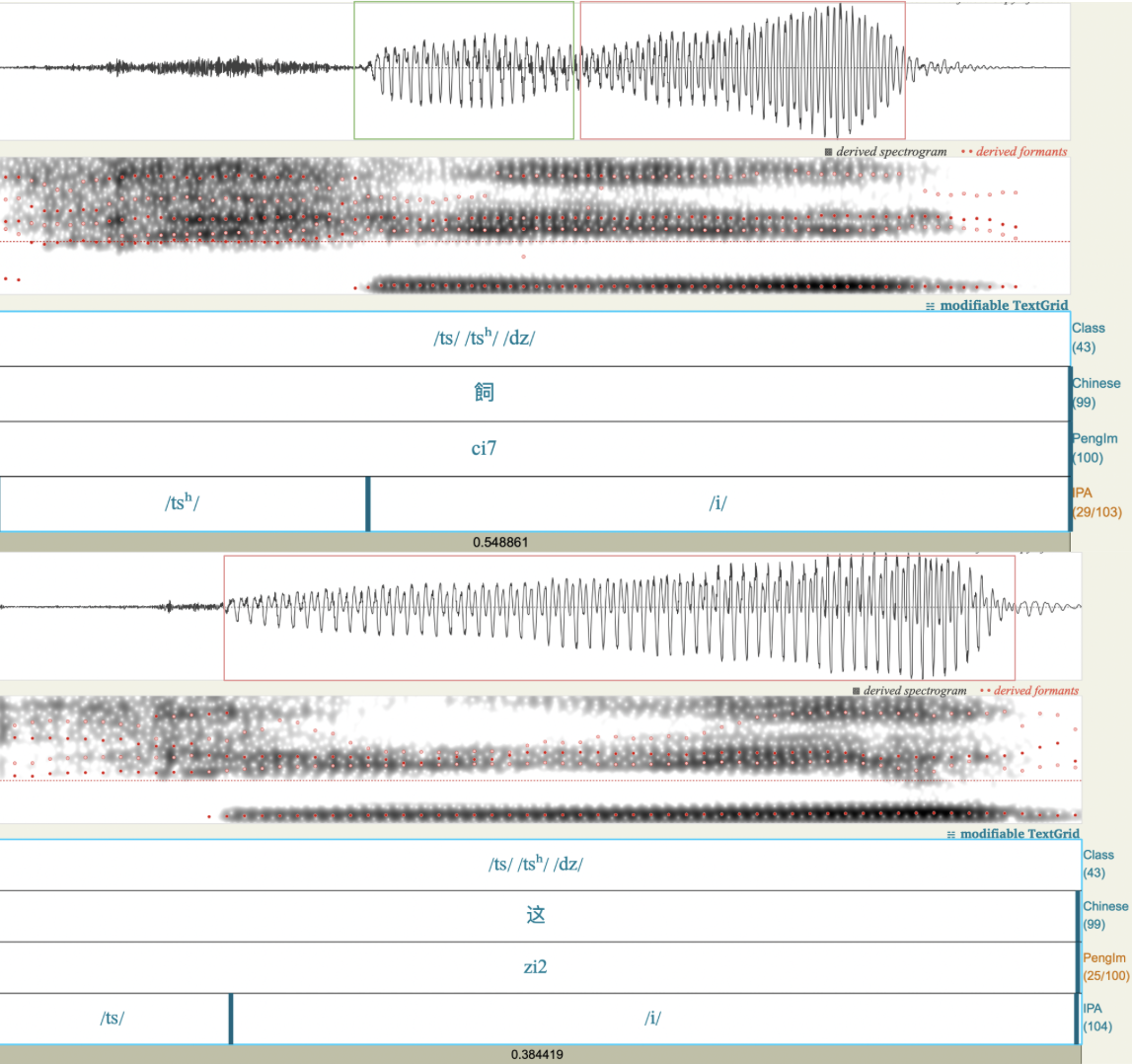
- However, the smallest difference in VOT is between the /
ts/ and the/tsʰ/with83 msand178 msrespectively- When looking at the
aspiratedversus theunaspirated alveolar affricate, theaspirated(top) signal seemsbiphasic4 - Since only the
aspirationdiffers in the minimal pair, it seems that after the/s/fricative release, there is not the completeglottal closurewe would expect from voicing. Rather the extra peak seems to be coming frommedial compressioncausing abreathy voiceat the beginning of the vowel- The spectrogram also confirms this as there is quite high energy frequencies on the onset of voicing in the signal
- When looking at the
- Thus, we can hypothesize that the
aspirated alveolar affricatecausesbreathy voicein the onset of the voicing in the next segment.- Since in
Teochewthere is only one onset consonant immediately followed by avowel nucleus, the vowel experiences this breathy voice
- Since in
State Timing Diagrams
- Based on the VOT and phonetic descriptions from the literature, we can infer state timing diagrams for the
stop consonantsinSwaTao - Below are the General Hypothesis on State Timing Diagrams of Gestural Constrictions
Using the Articulatory Phonology Gestural Descriptions for Consonants:
| Vocal Tract Constrictor/Organ | Description |
|---|---|
| Velic (Velum) | Controls the lowering of the velum and therefore nasalization |
| Tongue Tip | Controls Coronal Consonants (Alveo-dental, Alveolar, Post-Alveolar, Palatal) |
| Tongue Body | Controls Dorsal Consonants (Palatal, Velar, Uvular, Pharyngeal) |
| Labial | Controls Lip Aperture, Lip Rounding, and Lip Height |
| Laryngeal | Controls Glottal Aperture and Voicing (Large Glottal Aperture = voiceless) (Small Glottal Aperture = voiced) |
Stops
Unaspirated Voiceless Stops- Glottal Wide during the stop closure
- Glottis Narrow immediately following the release
Aspirated Voiceless Stops- Glottal Wide during the stop closure
- Glottal Adduction following the release for
>70 msbefore voicing begins
Voiced Stops- Glottal Closed throughout the stop closure and release (
synchronous5)
- Glottal Closed throughout the stop closure and release (
| Constrictor Description | State Timing Diagram |
|---|---|
| Labial | 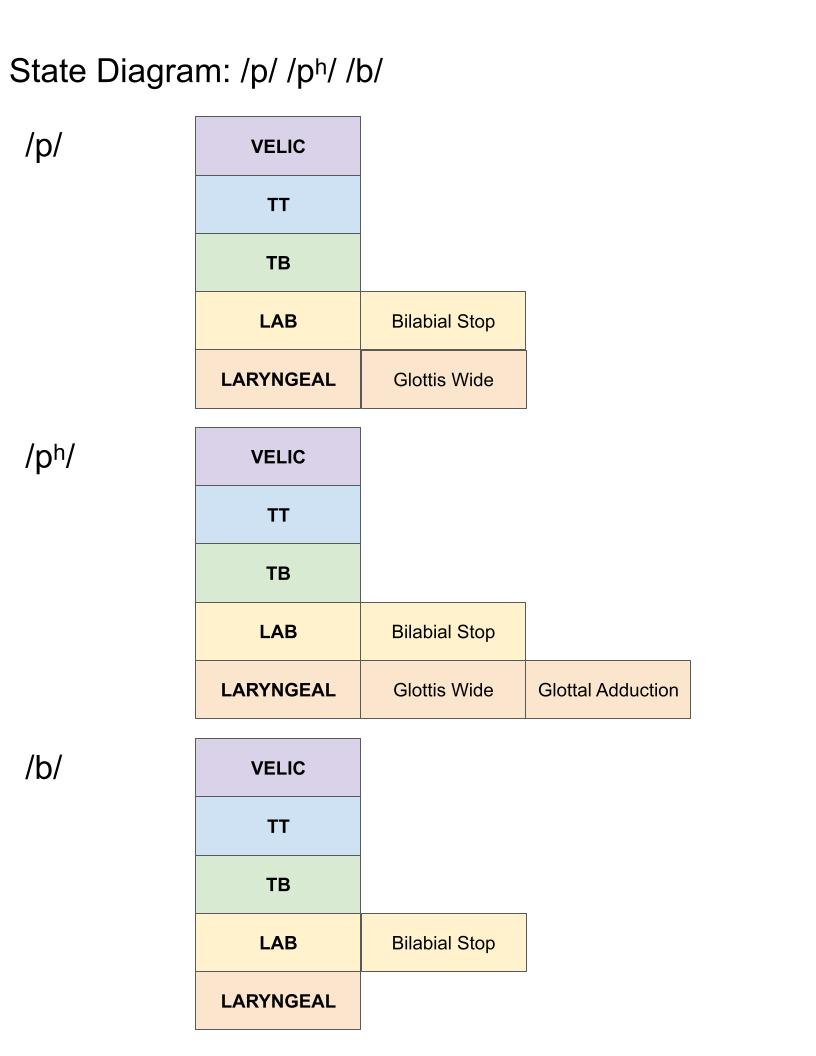 |
| Tongue Tip | 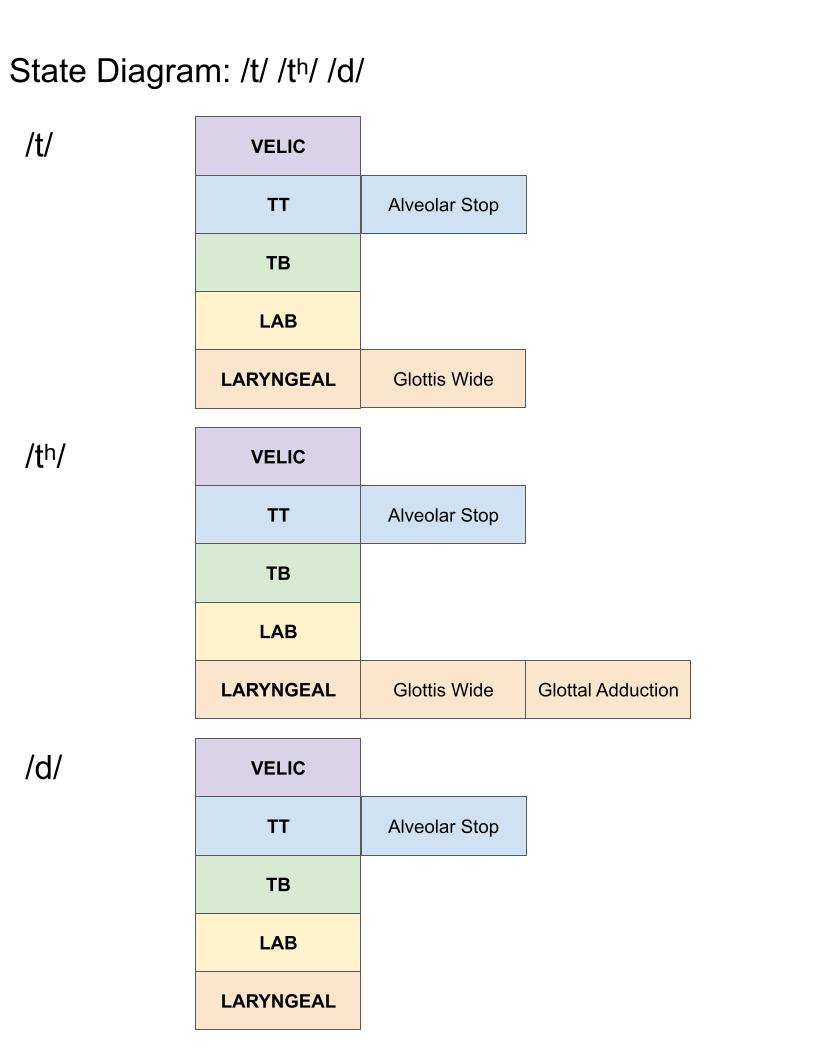 |
| Tongue Body | 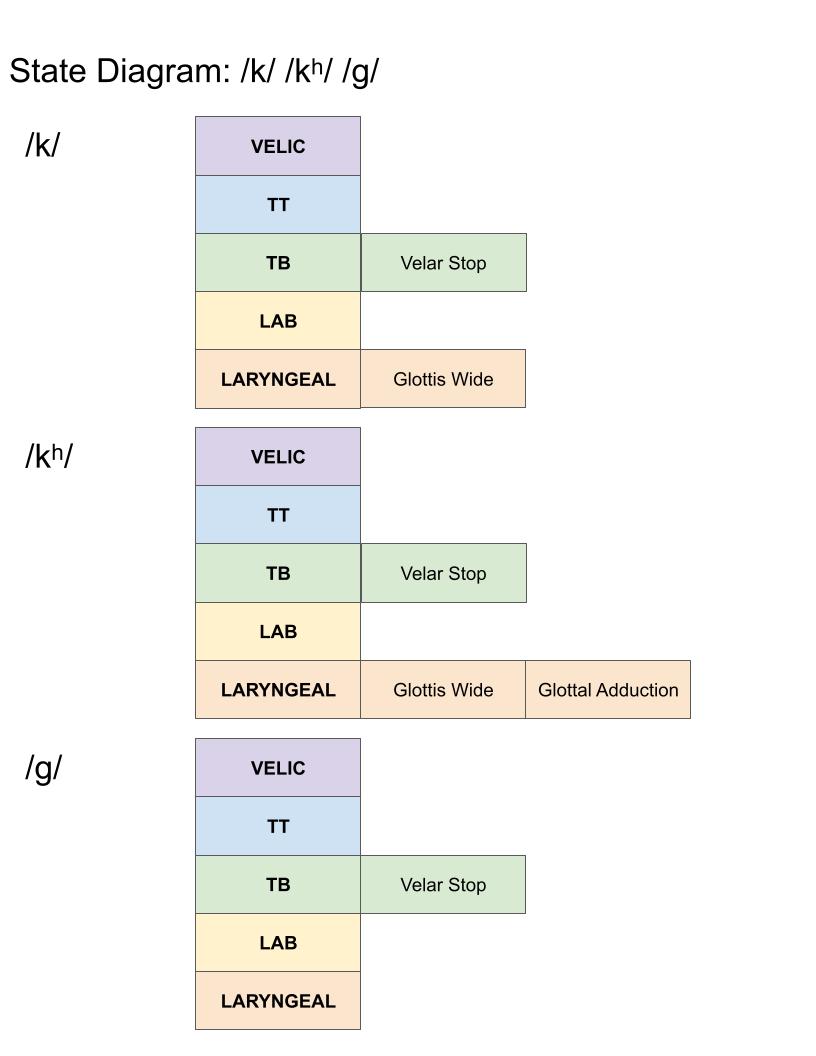 |
| Velum Lowering |  |
Fricatives
- Both fricatives in
SwaTaoare voiceless- Glottal Wide gesture is synchronous5 with the fricative
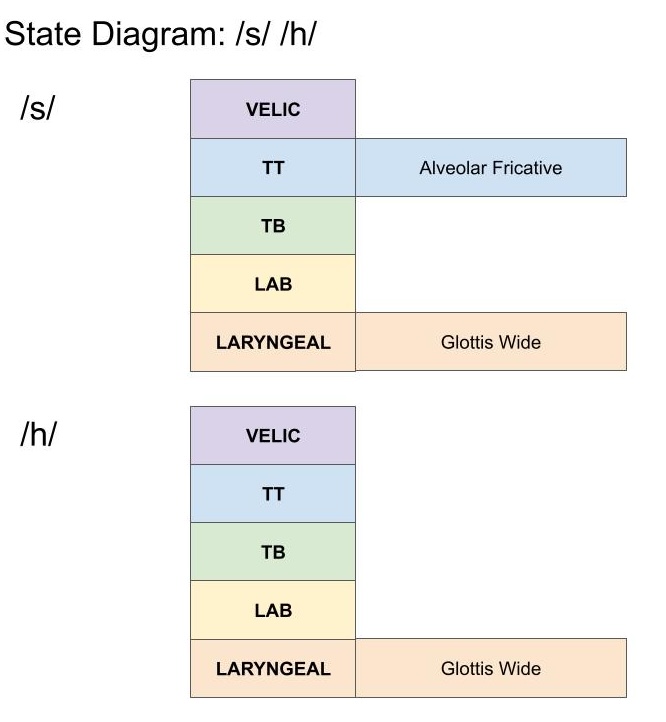
- Glottal Wide gesture is synchronous5 with the fricative
Affricates
All affricate in Teochew are alveolar and follow a similar pattern to the stops
Voiceless Unaspirated Affricate- Glottal Wide synchronous with Alveolar Stop and Alveolar Fricative
Voiceless Aspirated Affricate- Glottal Wide during Alveolar Stop and Alveolar Fricative
- Glottal Adduction and Medial Compression after onset voicing begins (
breathy voiceduring vowel)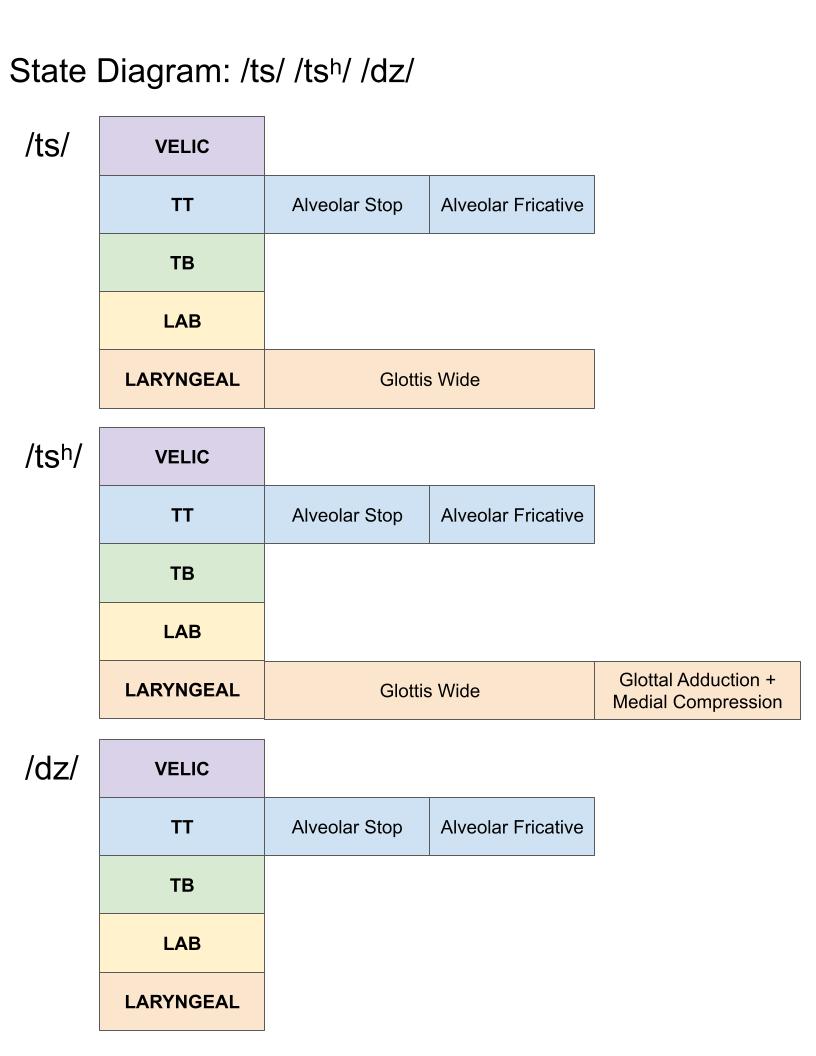
Liquids
There is only one liquid in Teochew, /l/ with two constrictions: alveolar and uvular 
Stop Consonant Cluster Release
Since SwaTao follows a /CVC/ where the consonants are optional and nucleus is either a single-vowel or diphthong, there are no consonant clusters.
-
Most words and transcriptions are first sourced from the
Learn Teochewresource. ↩ -
The
/mɪŋ/,/o/, and the/hoʔ/needed to be changed from the original transcription based on the speaker ↩ -
Originally, the sentences was /lʌ/ /do/ /laɪ/ /u/ /leŋ/ /moŋ/ /a/ /bo/; however the speaker found that adding the extra /do/ was ungrammatical. Thus, it is removed from the recording and transcription ↩
-
Biphasicwith respect to a waveform means that there are two up and down phases in the same wave ↩ -
Synchronousrefers to the idea that two gestures begin and end at the same time (“in sync”) rather than being out of sync (ex:Glottal Adductionafter aStop Releasecausing `aspiration) ↩ ↩2